The Very Best in Preservation

Recipients of the 2011 National Preservation Awards include individuals and projects epitomizing …

By Magazine Editors | From Preservation | November/December 2011 

2011 National Preservation Awards

Pamela
Pamela Bates

Credit: Matt Teuten

The Peter H. Brink Award for Individual Achievement: Pamela Bates, Lowell’s Boat Shop

Pamela Bates grew up landlocked in Longmeadow, Mass. But as the daughter of an accomplished fly-fisherman, “I was always gravitating toward the water,” she says. In the 1970s, she and her husband moved to the Massachusetts coast and discovered Lowell’s Boat Shop, then a commercial boat-building operation: “I would just go to the boat shop for the joy of purchasing oar locks,” she says. 

The country’s oldest continuously operating boat shop, Lowell’s was founded in 1793 on a stretch of the Merrimack River about 40 miles northeast of Boston. Known for its wooden dories, the shop remained in the Lowell family until 1976, when it was sold.

Lowell’s changed hands again in 1992, when the Newburyport Maritime Society acquired the property and committed to preserving the boat shop as a working museum. But little more than a decade later, its commitment was imperiled. Unable to support the shop financially, the society was forced to sell.

With developers eyeing the prime waterfront location, Bates assembled a coalition (later called the Lowell’s Maritime Foundation) which purchased the landmark. The nonprofit took title in 2007 and has operated Lowell’s ever since. Bates serves as the foundation’s executive director.

In that time, says her colleague Graham McKay, the number of employees grew from zero to three, the shop received grant funding for a new roof and windows, and boat production increased from one boat per year to eight. Lowell’s, he says, “has gone from being quiet and unwelcoming to a vibrant and inviting working museum. For all this work, Pam Bates has not received one penny.”

Focused on preserving and perpetuating the art and craft of wooden boat building, Lowell’s remains “a well-kept secret,” Bates says, but she is determined to change that. She hopes to expand existing dock space to accommodate more waterfront programming and start a rowing program for patients recovering from serious illnesses or those with special needs. Because every boat assembled at Lowell’s is handcrafted, she has a particular interest in establishing an apprentice program.

Bates has dedicated herself to Lowell’s for almost a decade but has no plans to retire. “The boat shop has a way of capturing people,” she says. “It’s a piece of living history … part of my heart.”  


American Brewery

As seen from the back seat of George Holback’s family station wagon more than 50 years ago, the American Brewery building in East Baltimore was “a place the Addams family might have lived.”

The five-story, Victorian-era structure, built in 1887 for the J.F. Wiessner & Sons Brewing Co., “was a big, scary, intimidating building,” Holback says. “But I knew it as the building I wanted to work on.”

Holback got his chance in early 2008, when Humanim, a nonprofit social services agency, chose his architectural firm, Cho Benn Holback + Associates, to design the rehabilitation of the building, which is located in one of Baltimore’s poorest neighborhoods, north of the Inner Harbor.

A $375,000 loan from the National Trust Loan Fund was used to stabilize the brewery, and the National Trust Community Investment Corporation pitched in $5.4 million in historic and new markets tax credit equity. Holes in the mansard roof, broken windows, and an interior filled with pigeon droppings at least six inches deep were just some of the challenges that work crews had to address during the 16-month, $24 million adaptive use project.

Humanim moved into the old brewery in April 2009. Offices and meeting spaces now fill rooms that once contained conveyor belts and grain chutes, and a new lighting system reveals architectural and industrial details obscured for decades. Last year, the Maryland Historical Trust recognized the success of the rehabilitation with its Project Excellence Award.

“You can see this building from all over the city, poking up over Clifton Park,” says Holback. “Now knitted into the old industrial relic is the story of a nonprofit trying to bring change to that area.”


Acworth Meetinghouse

For nearly two centuries, a beloved icon known locally as the Church on the Hill towered above the rooftops of Acworth, N.H. When residents noticed in 2005 that the steeple atop Acworth Meetinghouse was leaning, they sprang into action to save the 1821 building.

In January 2006, the steeple was removed and lowered onto pylons on the town common. Following recommendations from the New Hampshire Division of Historical Resources and using a grant from the New Hampshire Preservation Alliance, members of the restoration committee worked with timber-frame preservation specialist Arron Sturgis to complete a project assessment. With grants and private donations forthcoming, they initiated a five-year restoration.

Crews repaired water damage in the church basement and stabilized the bell tower from the bottom up, replacing rotten wood and bolstering posts. They also rewired the building, added exterior storm windows, repaired the shutters, and repainted the walls. (The renovated church also has accessible bathrooms and a much-needed kitchen.) In June 2009, the people of Acworth watched as the historic steeple was hoisted back into place.

By the time the restoration committee disbanded earlier this year, members had raised more than $330,000 for the nearly $640,000 project. Sturgis calculates that, by relying on local craftspeople, he cut projected costs by as much as 30 percent. Engaging the community in both grassroots fundraising and restoration earned the project high marks in the eyes of Preservation Awards judges.

Kathi Bradt, who worked for the Meetinghouse Restoration Committee, says that the fully restored building is “remarkable … it’s like a wedding cake sitting here in the middle of town.”


Downtown Women’s Center

The residents of the Downtown Women’s Center in Los Angeles have found a fresh start in their new home on San Pedro Street. And the same can be said of the center’s 1926 Gothic Revival structure, which reopened last December after a $26 million restoration.

Pica+Sullivan Architects transformed the space into a full-service facility for homeless and low-income women living on Los Angeles’ Skid Row. Per their plans, crews repaired the crumbling facade, updated all mechanical systems, and completed seismic work to bring the building up to code. They also created 71 new residential units with private baths and kitchenettes. Each residential floor features common areas, including computer and exercise rooms. There is also a library and a rooftop garden. The ground floor of the LEED Silver-certified building now houses a six-room health clinic, a small pharmacy, offices for a psychiatrist and social workers, and a mammogram room.

Forty local designers donated time and resources to decorate the apartment units and common spaces, creating an environment that CEO Lisa Watson calls a source of pride for the women at the center. And the residents were consulted every step of the way to ensure they had a voice in the creation of their new home.

“It’s a great example of how good design makes such an impact on our lives,” says Site Director Joseph Altepeter, echoing the thoughts of the Awards jurors who recognized the center for its ambitious restoration of a historic building.


Seashore Farmers’ Lodge 

The Seashore Farmers’ Lodge on the tiny barrier island of Sol Legare, S.C., was erected in 1915 to serve freedmen and their families who could not secure loans or insurance policies at white-run banks and firms in the segregated South. “This was our community center, this was our church, it was our school, it was our funeral home,” local resident Ernest L. Parks says. “It was everything.”

The site has a distinguished history. The famed 54th Massachusetts Regiment, the first official black unit to fight in the Civil War, camped there before the Battle of Sol Legare and the assault on Fort Wagner (made famous in the film Glory) in 1863. The building was constructed by residents who collected contributions toward the cost of materials.

But by the 1960s, limited funds, tropical storms, and the northern migration of many African Americans had nearly doomed the structure. After residents built a new community center down the road in the 1970s, the lodge was left abandoned for almost 30 years.

In 2005, Parks returned to his hometown after years away and joined Bill “Cubby” Wilder, a former town councilman, in trying to save the deteriorating lodge. At Wilder’s urging, the Town of James Island (which had authority over Sol Legare) offered $55,000 to jump-start restoration work in 2006. The lodge’s appearance on the A&E program Flip This House, and a 2007 listing on the National Register of Historic Places, attracted additional volunteer attention and funding.

Starting in March 2009, workers shored up the side of the building; removed, cleaned, and replaced pine siding; hand-dug continuous footers where the lodge’s original palm trunk foundation had rotted; and replaced a hurricane-damaged balcony. Members of the Concerned Citizens of Sol Legare Foundation’s Ad Hoc Committee and other volunteers collected furniture and heirlooms to display inside. Innovative educational programming is one reason the project was recognized by Preservation Awards judges.

Initial estimates to rescue the lodge neared $400,000. Yet when the lodge reopened in April, total costs were less than $140,000. “There’s nothing like this,” says Corie Hipp, the project’s marketing coordinator. “Nothing like this anywhere.”

2011 AIA Tri State Design Award Winner!

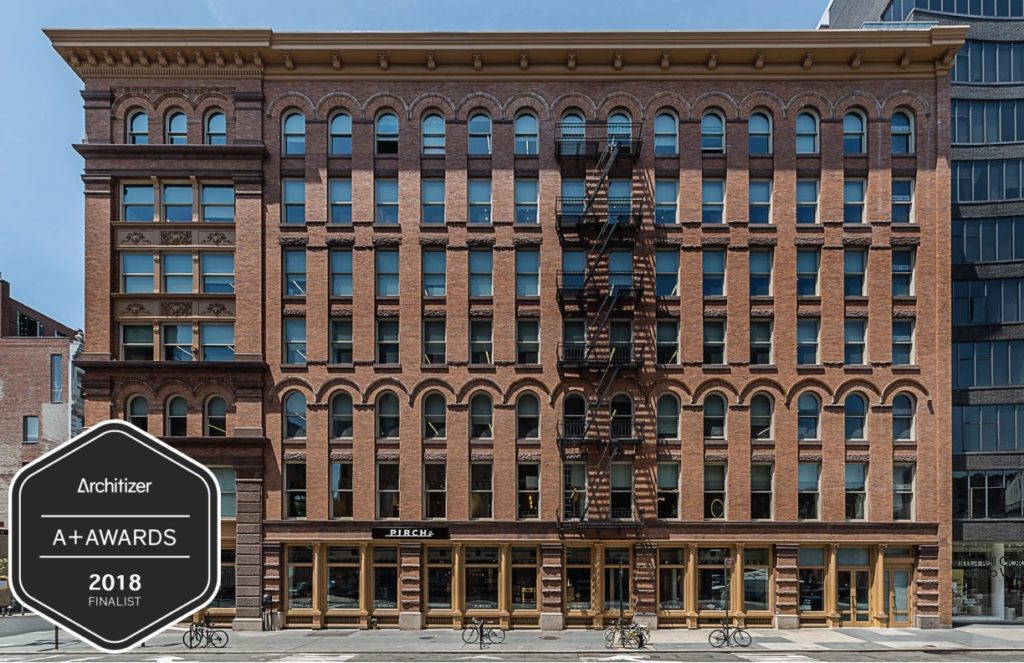
We are proud to announce our project “648 Broadway, New York, New York” was selected for a 2011 AIA Tri-State Design Award for Historic Preservation.

Go to AIA Tri-State Design Award

2011 AIA New York State Design Award Winner!

We are proud to announce our project “648 Broadway, New York, New York” was selected for a 2011 AIA New York State Design Award for Historic Preservation. We will be recognized during the President’s Dinner and Design Awards Presentation on Wednesday, September 21, 2011 at the Tri-State Convention in Atlantic City, NJ.


2011 AIANYS Design Award Jury Meetsda jury

      The 2011 AIANYS Design Award jury met June 8-9 at the 74 State Hotel in Albany to review the Design Award portfolios and choose the recipients. The Design Awards will be presented during the convention at the AIANYS Dinner and Design Awards Presentation on Wednesday, September 21 at Bally’s. The names of all of the Design Award recipients are below. We would like to thank all of the jury members for their time and hard work.

     Pictured (left to right): Robert Shibley, FAIA, Dean, School of Architecture and Planning, University at Buffalo; Robert M. Noblett, AIA, Partner, Benisch Arkitekten, Boston, MA; Michael Ryan, AIA, Michael Ryan Architects, Loveladies, NJ; Elizabeth Egbert, President & CEO, Staten Island Museum, Staten Island, NY (Public Member) and David Mark Riz, AIA, Principal, KieranTimberlake, Philadelphia, PA (Jury Chair).

2011 AIANYS Design Award Recipients

     AIANYS is pleased to announce the 2011 Design Award recipients. They will all be recognized during the President’s Dinner and Design Awards Presentation on Wednesday, September 21, 2011 at Bally’s in Atlantic City, NJ. There are three levels of awards: Award of Excellence, Award of Merit and Citation for Design. A “Best in New York State” Award has also been awarded. The recipient of that award will be revealed at the Design Awards Presentation.
     The design categories are: Adaptive Reuse; Commercial/Industrial, Large Projects and Small Projects; Historic Preservation; Institutional; Interiors; International; Residential, Large Projects and Small Projects; Unbuilt and Urban Planning/Design.
A four-color Design Awards book featuring photos, narratives and jury comments of all of the award-winning projects will be sent out to all AIANYS members in the Fall after the convention.
     Congratulations to all of the recipients!

ADAPTIVE REUSE
Awards of Merit: El Museo Del Barrio, New York, New York, Gruzen Samton Architects, LLP, New York, New York

Orchestra of St. Luke’s DiMenna Center, New York, New York, H3 Hardy Collaboration Architecture, New York, New York

Wyckoff Exchange, Brooklyn, New York, Andre Kikoski Architect, PLLC, New York, New York

Citation for Design: East Hampton Town Hall, East Hampton, New York, Robert A.M. Stern Architects, LLP, New York, New York

COMMERCIAL/INDUSTRIAL-LARGE PROJECTS
 Awards of Merit: The Bridge, Bridgehampton, New York, Roger Ferris + Partners, Westport, Connecticut

Comcast Center, Philadelphia, Pensylvania, Robert A.M. Stern Architects, LLP
New York, New York, Kendall/Heaton Associates, Inc., Houston, Texas, Associate Architect

Newtown Creek Wastewater Treatment Plant, Brooklyn, New York, Ennead Architects, New York, New York, Design Architect, Greeley-Hansen, New York, New York, Architects/Engineers of Record, Hazen & Sawyer, New York, New York, Architects/Engineers of Record, Malcolm Pirnie, White Plains, New York, Architects/Engineers of Record

COMMERCIAl/INDUSTRIAL-SMALL PROJECTS
 Award of Excellence: Marc Jacobs Flagship Building, Tokyo, Japan, Jaklitsch/ Gardner Architects PC, New York, New York, Creative Designers International
Tokyo, Japan, Architect of Record-Building Shell, D. Brain Co., LTD, Tokyo, Japan,
Architect of Record-Interiors

HISTORIC PRESERVATION
Award of Excellence: Thomas Edison National Historical Park, West Orange, New Jersey, Beyer Blinder Belle Architects & Planners, New York, New York

Citations for Design: 648 Broadway, New York, New York, Scott Henson Architect LLC, New York, New York

New York Public Library, Exterior Restoration, New York, New York, Wiss, Janney, Elstner Associates, Inc., New York, New York

INSTITUTIONAL
Award of Excellence: Cornell Plantations Welcome Center, Ithaca, New York, Baird Sampson Neuert Architects, Toronto, Canada

Awards of Merit: New York City Fire Department, Bronx, New York, Ennead Architects, New York, New York

The Stephen Sondheim Theatre, New York, New York, Cook + Fox Architects, LLP
New York, New York, Adamson Associates Architects, New York, New York, Executive Architect

Citations for Design: Union County Juvenile Detention Center, Linden, New Jersey, Ricci Greene Associates, New York, New York

United States Land Port of Entry, Calais, Maine, Robert Siegel Architects, New York, New York
  
INTERIORS
Award of Excellence: Inverted Warehouse/Townhouse, New York, New York, Dean/Wolf Architects, New York, New York

Award of Merit: Grey Group, New York, New York, STUDIOS Architecture, New York, New York

Citation for Design: Infinity Chapel, New York, New York, Hanrahan Meyers Architects, LLP, New York, New York

INTERNATIONAL
Award of Excellence: Taichung InfoBox, Taichung, Taiwan, Stan Allen Architect
Brooklyn, New York, W.B. Huang Architects & Planners, Taichung City, Taiwan, Associate Architect

RESIDENTIAL-LARGE PROJECTS
Award of Merit: The Schermerhorn, Common Ground Community, Brooklyn, New York, Ennead Architects, New York, New York

Citation for Design: William Beaver House, New York, New York, Tsao & McKown Architects, New York, New York, Design Architect, SLCE Architects, New York, New York, Architect of Record

RESIDENTIAL-SMALL PROJECTS
Award of Merit: House for “Locavore” Farmers, Geyserville, California, Cooper Joseph Studio, New York, New York, Richardson Architects, Mill Valley, California, Associate Architect

UNBUILT
Citations for Design: Bike Hanger, (location unavailable), Jeeyong An, AIA, Manifesto Architecture PC,
New York, New York

St. Ann’s Warehouse, Brooklyn, New York, Geoff Lynch, AIA, H3 Hardy Collaboration Architecture, New York, New York

URBAN PLANNING DESIGN
Award of Excellence: SandRidge Commons, Oklahoma City, Oklahoma, Rogers Marvel Architects, New York, New York

Award of Merit: Zipper Park Bench System,New York, New York, WXY architecture + urban design, New York, New York

Citation for Design: MTA Flood Mitigation, Queens, New York, Rogers Marvel Architects, New York, New York, Di Domenico + Partners, Long Island City, New York

Go to AIANYS

GNA Award of Excellence

GNA Award of Excellence was presented to 38 Gramercy and Scott Henson at Brotherhood Synagogue on January 26, 2011.

 Dear Awards Committee,

I am writing this letter to support the nomination of Scott Henson Architect for the restoration of 38 Gramercy Park North. In support of this project, I would like to highlight the opportunity the restoration project has taken to engage the design of the building with the historic character of the streetscape and neighborhood, and the positive effect the restoration of this once deteriorating building has had on the community.

Under the guidance of Scott Henson Architect, the design for the altered facade addressed not only the historic aesthetic but accommodated the modern adaption of itsuse. As a result, Scott Henson Architect has found a balance between merging historic authenticity with modern practicalities. This effort was recognized at our annual “Celebration of Gramercy” held at Brotherhood Synagogue where an Award of Excellence was presented to 38 Gramercy and Scott Henson.

Sincerely,

Alan Krevis

President
Gramercy Neighborhood Associateds Inc.


Go to GNA
Go to 38 Gramercy

Gramercy Neighborhood Associates Inc.

Annual GNA Meeting and Celebration of Gramercy
January 26, 2011

Annual Celebration of Gramercy event will be held on Wednesday, January 26th, 2011 at 6:30pm at the Brotherhood Synagogue on Gramercy Park. O. Aldon James, current President of The National Arts Club on Gramercy Park, will be our guest speaker. 
Annual Gramercy building restoration award will be announced in addition to the winners of our Annual Photography Contest at the event.

Celebration of Gramercy GNA photo contest winner!


Go to GNA